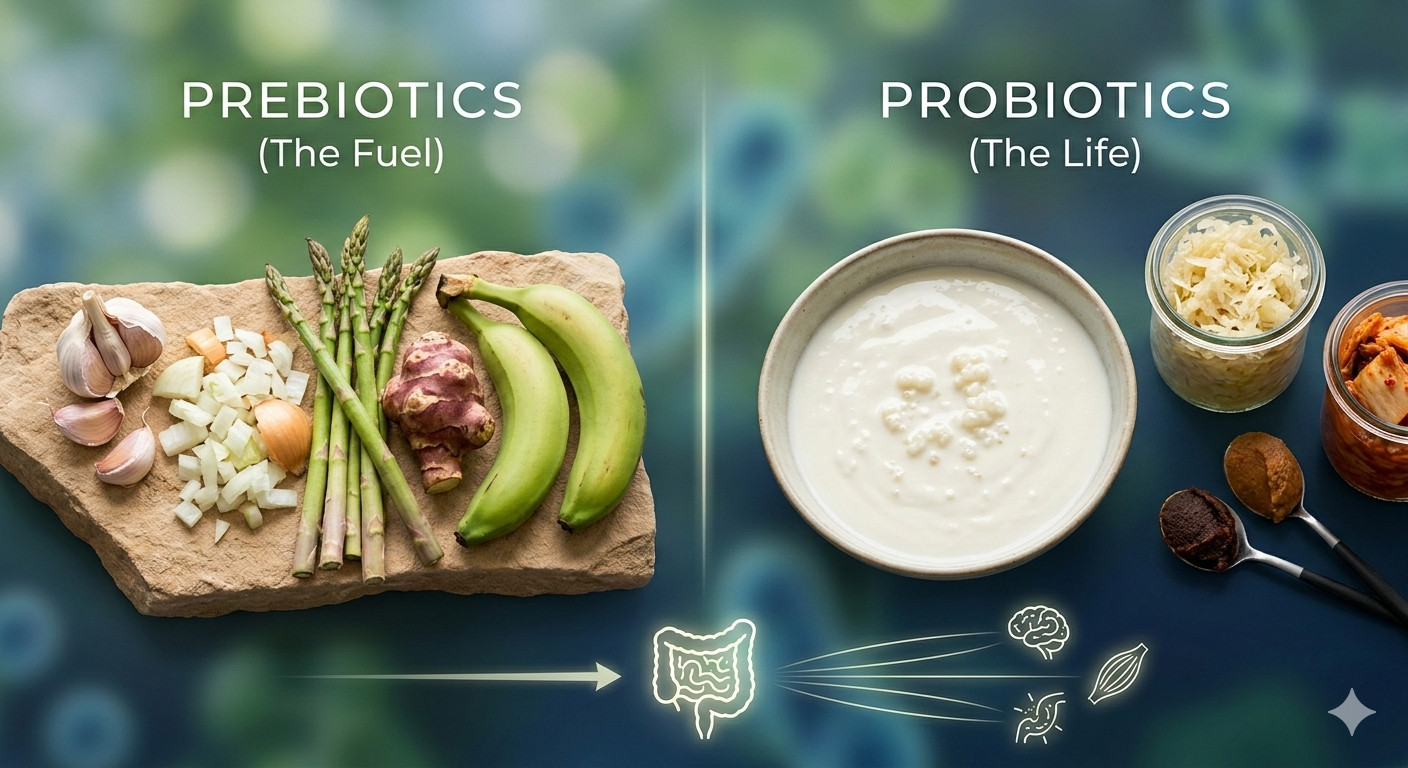
This in-depth interview focuses on the biochemical synergy between prebiotics and probiotics. By moving beyond marketing jargon, we explore how these elements function at a cellular level to influence human health, from metabolic markers to mental well-being.
The Foundation of Gut Ecology
Question: In the world of health and wellness, “gut health” is often discussed with a lot of enthusiasm but very little precision. If we strip away the marketing, what is the core functional difference between a prebiotic and a probiotic?
Answer: To understand the difference, you have to view the human digestive tract as a complex, internal ecosystem—much like a rainforest. Probiotics are the living “wildlife” of that ecosystem. They are exogenous, live microorganisms (mostly bacteria like Lactobacillus or Bifidobacterium) that, when ingested, provide a health benefit. However, they are often transient; they don’t necessarily move in and stay forever; they act as “migratory workers” that perform specific tasks while passing through.
Prebiotics, by contrast, are the “habitat” and the “food source.” Technically, they are non-digestible food ingredients—mostly specialized fibers—that pass through the small intestine untouched. They reach the colon, where they are selectively fermented by beneficial bacteria.
If you take probiotics without prebiotics, you are essentially introducing new workers into a factory where there is no electricity and no raw materials. They cannot do their jobs. To see a systemic change in health, you need both: the organisms and the fuel that allows them to produce beneficial metabolites.
Beyond Digestion – The Rise of Postbiotics
Question: Most people take these for bloating or “regularity.” But modern research suggests the benefits are much more systemic. How do these substances actually influence the rest of the body?
Answer: This is where the science has evolved most rapidly. We now know that the primary benefit of the microbiome isn’t just “digestion”—it is metabolic signaling. When beneficial bacteria ferment prebiotic fibers, they produce compounds called Postbiotics, specifically Short-Chain Fatty Acids (SCFAs) like Butyrate, Propionate, and Acetate.
These SCFAs are the real “magic” of the gut.
- Butyrate is the primary fuel for the cells lining your colon. It keeps the intestinal barrier “tight,” preventing leaky gut syndrome.
- Propionate travels to the liver to help regulate cholesterol production and glucose metabolism.
- Acetate enters the peripheral circulation and can even cross the blood-brain barrier to influence appetite and neuro-inflammation.
So, when we talk about prebiotics and probiotics, we aren’t just talking about “fixing a stomach ache.” We are talking about managing systemic inflammation and metabolic health at a molecular level.
The Psychobiotic Revolution (The Gut-Brain Axis)
Question: There is a growing body of evidence regarding the “Gut-Brain Axis.” Can you explain the experiment-based reality of how our microbiome dictates our mood and mental health?
Answer: The gut is often called the “Second Brain” because it contains the enteric nervous system, which uses the same neurotransmitters as the brain. In fact, more than 90% of your serotonin and roughly 50% of your dopamine are produced in the gut.
A landmark study (the Bravo et al., 2011 experiment) demonstrated this by feeding mice a specific probiotic, Lactobacillus rhamnosus. These mice showed significantly lower levels of stress hormones and reduced anxiety behaviors. However, when the researchers cut the Vagus Nerve—the direct “phone line” between the gut and the brain—the probiotic stopped working.
This proves that the bacteria in your gut are literally “talking” to your brain. If your microbiome is fed the wrong foods (sugar and processed fats), it sends signals of distress and inflammation, which can manifest as brain fog, anxiety, or depression. By using targeted prebiotics and “psychobiotics” (probiotics that benefit mental health), we can theoretically treat mood disorders through the digestive tract.
Metabolic Control and Weight Management
Question: Is there any scientific truth to the idea that prebiotics and probiotics can help with weight loss or insulin resistance?
Answer: Yes, but it’s not a “fat-burning pill” mechanism. It’s about microbial diversity. Research, such as the Akkermansia study (Nature Medicine, 2019), showed that overweight individuals often lack a specific bacterium called Akkermansia muciniphila.
When these individuals were given this bacterium as a probiotic, they saw significant improvements in insulin sensitivity and a reduction in systemic inflammation markers, even without drastic caloric changes. Prebiotics like Inulin and Fructo-oligosaccharides (FOS) also stimulate the release of GLP-1 (glucagon-like peptide-1), which is the same hormone targeted by modern weight-loss medications. They naturally tell the brain you are full and help the body process sugar more efficiently.
Practical Implementation – Food vs. Supplements
Question: For someone looking to optimize their health, should they focus on high-dose supplements or can they achieve these results through diet alone?
Answer: For a healthy person, diet is the primary tool.
- For Prebiotics: You need “The Fiber Diversity.” This means eating Jerusalem artichokes, garlic, leeks, onions, asparagus, and slightly under-ripe bananas. These are the gold standard for feeding your native bacteria.
- For Probiotics: Fermented foods like Kefir, Kimchi, and Sauerkraut are far more effective than most supplements because they contain a “consortium” of different species working together, rather than just one or two isolated strains.
However, supplements are necessary for clinical interventions. If you have just finished a course of antibiotics, you need a high-dose probiotic to “re-seed” the gut. If you have a specific condition like IBS or Colitis, you need strain-specific probiotics (like Lactobacillus plantarum 299v), as a general “grocery store” probiotic might not have the strength or the specific species required to survive the stomach acid.
Potential Risks and the “Leaky Gut” Caution
Question: Are there any instances where prebiotics or probiotics can be harmful?
Answer: Absolutely. This is a crucial point. If someone has SIBO (Small Intestinal Bacterial Overgrowth), taking prebiotics is like adding fuel to a fire. The bacteria are already in the wrong place (the small intestine instead of the colon), and feeding them will cause extreme gas, bloating, and pain.
Furthermore, those with severely compromised immune systems should be cautious with probiotics, as introducing live bacteria into a fragile system can occasionally lead to infections. Always focus on “Low and Slow”—start with small amounts of fermented foods or fiber and increase gradually to allow your internal ecosystem to adapt.
Scientific References and Empirical Evidence
- Metabolism: Depommier et al. (2019) – “Supplementation with Akkermansia muciniphila in overweight and obese human volunteers.” Published in Nature Medicine. This study showed that specific bacteria can improve insulin resistance and metabolic markers.
- Gut-Brain Connection: Bravo et al. (2011) – “Ingestion of Lactobacillus strain regulates emotional behavior and central GABA receptor expression.” Published in PNAS. This trial confirmed the Vagus nerve connection between gut bacteria and the brain.
- Immune Response: Hao et al. (2015) – “Probiotics for preventing acute upper respiratory tract infections.” Cochrane Database of Systematic Reviews. A meta-analysis showing that probiotics significantly reduce the duration and severity of the common cold.
- Short-Chain Fatty Acids: Koh et al. (2016) – “From Dietary Fiber to Host Physiology: Short-Chain Fatty Acids as Key Bacterial Metabolites.” Published in Cell. This paper outlines exactly how prebiotics transform into health-promoting postbiotics.